Computers in Developing Nations: A Cautionary Tale (1977)
A 1977 cautionary tale about computing in developing nations, and why programmers resisted Arabic compilers in the 1970s.
Series: arabic.computer
Another important article that I found is about computers for the non-English world, and it focuses on the Arabic language. The article is from Personal Computing, February 1978. The key insights of the article are: English-based programmers in both the English-speaking and French-speaking Arab countries have pushed against Arabic-based compilers because it would break a status quo that gave them job security. IBM had a strong influence in the Arab world in the 70s. The programming language PL/1 was an integral part of their offering due to their IBM 360 machines. Because of the fierce opposition to having an Arabic compiler, the more favorable English version remained, and Arabs lost a chance to have an important Arabic-based system in the 70s.
The magazine reprinted the article from the December 1977 edition of Communications of the ACM. The article’s author is Theodore Sterling.
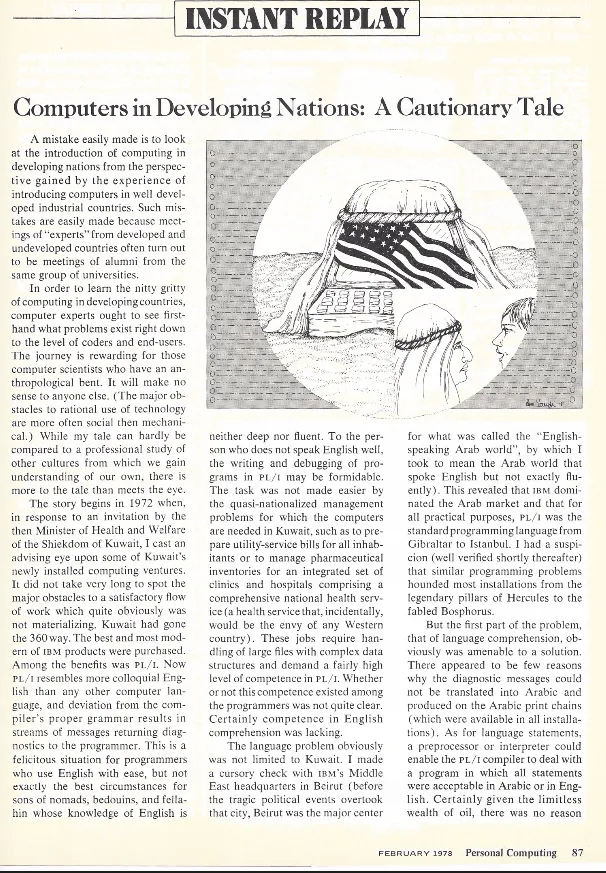
The article is below
Computers in Developing Nations: A Cautionary Tale
A mistake easily made is to look at the introduction of computing in developing nations from the perspective gained by the experience of introducing computers in well developed industrial countries. Such mistakes are easily made because meetings of “experts” from developed and undeveloped countries often turn out to be meetings of alumni from the same group of universities.
In order to learn the nitty gritty of computing in developing countries, computer experts ought to see firsthand what problems exist right down to the level of coders and end- users. The journey is rewarding for those computer scientists who have an anthropological bent. It will make no sense to anyone else. (The major obstacles to rational use of technology are more often social then mechanical.) While my tale can hardly be compared to a professional study of other cultures from which we gain understanding of our own, there is more to the tale than meets the eye.
The story begins in 1972 when, in response to an invitation by the then Minister of Health and Welfare of the Sheikhdom of Kuwait, I cast an advising eye upon some of Kuwait’s newly installed computing ventures. It did not take very long to spot the major obstacles to a satisfactory flow of work which quite obviously was not materializing. Kuwait had gone the 360 way. The best and most modern of IBM products were purchased. Among the benefits was PL/1. Now PL/1 resembles more colloquial English than any other computer language, and deviation from the compiler’s proper grammar results in streams of messages returning diagnostics to the programmer. This is a felicitous situation for programmers who use English with ease, but not exactly the best circumstances for sons of nomads, bedouins, and fellahin whose knowledge of English is neither deep nor fluent. To the person who does not speak English well, the writing and debugging of programs in PL/1 may be formidable. The task was not made easier by the quasi- nationalized management problems for which the computers are needed in Kuwait, such as to prepare utility- service bills for all inhabitants or to manage pharmaceutical inventories for an integrated set of clinics and hospitals comprising a comprehensive national health service (a health service that, incidentally, would be the envy of any Western country). These jobs require handling of large files with complex data structures and demand a fairly high level of competence in PL/1. Whether or not this competence existed among the programmers was not quite clear. Certainly competence in English comprehension was lacking.
The language problem obviously was not limited to Kuwait. I made a cursory check with IBM’s Middle East headquarters in Beirut (before the tragic political events overtook that city, Beirut was the major center for what was called the “Englishspeaking Arab world”, by which I took to mean the Arab world that spoke English but not exactly fluently). This revealed that IBM dominated the Arab market and that for all practical purposes, PL/1 was the standard programming language from Gibraltar to Istanbul. I had a suspicion (well verified shortly thereafter) that similar programming problems hounded most installations from the legendary pillars of Hercules to the fabled Bosphorus.
But the first part of the problem, that of language comprehension, obviously was amenable to a solution. There appeared to be few reasons why the diagnostic messages could not be translated into Arabic and produced on the Arabic print chains (which were available in all installations). As for language statements, a preprocessor or interpreter could enable the PL/1 compiler to deal with a program in which all statements were acceptable in Arabic or in English. Certainly given the limitless wealth of oil, there was no reason why the Arab world could not be supplied with an Arabic version of PL/I. It was even fortunate that an Arab student was among my graduates at that time, completing his thesis on a software problem for which PL/I was the major language. My report to the sponsor and a recommendation to IBM International was to furnish the sensible and needed extension of software by providing a translation for all diagnostic messages into Arabic and adding a preprocessor to the PL/I compiler that would accept source statements in Arabic. What could be easier? What followed was far from simple. It was a curious sequence of events which showed the complexity of the human psyche to its best advantage. Immediate and bitter protest to the proposal came from a source which I least expected would object – the programmers themselves. Technically competent individuals are a scarce resource in developing countries, and those who in addition must speak English to perform a job make up a very small subset. Thus the programmer’s ability to speak English was an important factor assuring job security and a high level of pay. Facility management was no less opposed to the proposal although less outspoken against it. Again, while the advantages of an Arabic compiler could not be denied, there were greater advantages requiring management to be conversant in English. Politically the usefulness of the language restriction was quite apparent as all top level management positions had to be held by bedouins, natives of Kuwait, few of whom spoke English. The effective management of facilities was conducted by immigrants from Egypt or Palestine whose position to a large extent depended upon their ability to supervise Englishspeaking employees in the task that required the mastery of English. The Arabic compiler would have eliminated the leverage exercised by the associate manager over a variety of management- level positions.
Nevertheless, IBM International agreed that there was a great deal of merit to the idea of supplying some sort of translation mechanism such as a tree- structured dictionary or encyclopedia for the purpose of guiding the perplexed Arab programmer through the intricacies of semantic pitfalls which systems- oriented language offered. While clearly not an optimal solution, producing the reference dictionary would have been of some use to the region. But then another obstacle arose quite unexpectedly from the so- called Frenchspeaking Arab world.
The French- speaking Arab world by extension is the area of North Africa in which French is spoken and with a somewhat greater fluency than English is spoken in the Middle East. It turned out however that the Frenchspeaking Arab world also used IBM equipment and PL/I. Within the relatively large supply of French- speaking technically trained Arabs, those who speak English occupy again a more favorable position and their objections to any tampering with the status quo was indeed fast and vehement. The strenuous resistance by the Paris office of International IBM scuttled the project altogether. And there the battle rests.
The inanity of this situation is by no means limited to the Arabs. In 1972 while attending to a similar need of the Israelis, I suggested that although Israeli programmers were more fluent in English than their Arab counterparts, they too could have profited by a Hebrew prepro- cessor and translation of diagnostic messages to their mother tongue. Again, the objection was no less ve- hement among the Israelis than it had been among their Arab counterparts. In fact, the wording of arguments against the proposal reflected similar feelings among Arabs and Israelis. (So striking was the similarity of arguments that for a mad moment I suspected a secret cabal between Israeli and Arab programmers- and for all I know there might be one.)
Since those days I have run into the same or similar attitudes on other occasions. The last time was during a meeting sponsored by the International Atomic Energy Agency which brought together radiation therapists and computer experts from South American and Asian countries. Radiation therapy has profited immeasurably from the computer- produced radiation- treatment plans and there are a number of systems which will permit near- optimal plans to be devised in interactive procedures. Using any of these systems unfortunately depends upon a thorough knowledge of English. Again the problem in developing countries appears to be the shortage of technically trained English- speaking personnel who may be spared from other computing tasks to work with the radiation therapists on treatment planning problems. My suggestion of providing interpreters for the various packages that would enable them to be manipulated in the native tongue of the technicians turned out to be as welcome as a case of the yaws. While hardware systems especially put together to permit radiation treatment planning are now being installed the world over, accompanying software consistently uses English, leading to an increasing competition for the already short supply of English- speaking technicians the world over. This may all be to the good of the English- speaking part of the globe but what benefits accrue from this to the rest of mankind?
I was very surprised that the discussion summarized by E. Robertson [1] of the panel on “Computers in Developing Nations” does not even touch upon the crucial problem of translating software into nCLs (Native Compatible Languages). This is not to say that software in “native” languages will open new channels for better planning and allocation of scarce resources among Third World countries. But it will help upgrade a large number of their citizens and gives them access to an important new technology.
There is yet one more implication of this same language issue which relates to us, here, in our highly developed technical society. Are we not also to some extent victimized by the same forces that prevent the implementation of more useful compilers in underdeveloped nations? Fortran and Cobol have maintained an iron grip on programming in Canada, the United Kingdom, and the United States, even though, for all practical purposes, PL/I is a much easier language to learn, to use, and in which to develop software. We find Fortran taught to half the students in business schools on the North American continent and the teaching of Fortran in general, with the almost natural way of teaching bad programming habits, is deeply ingrained in many otherwise foresighted and topnotch universities. Why did naturally modular PL/I not take hold more quickly? Why is the use of PL/I resisted by programmers and management alike? Also why do programmers, who “speak” PL/I, again resist the introduction of specialized or general languages more suitable to their tasks? To what extent are the motivations similar for faculty in a business school or in a chemistry department who will fiercely defend a Fortran territory and require their students to learn a language which is poorly suited for character and string manipulations?
However, this cautionary tale is about developing (or what we used to call underdeveloped) countries, and surely (?) no lessons from these would apply to us here.
- Computers in developing nations. Computers and Society 7 (1976), 7-9.
Reprinted from Communications of the ACM, Theodor D. Sterling, Simon Fraser University, Burnaby, B.C., Canada. Volume 20, No. 12. December, 1977.
Link to the article https://archive.org/details/197802